Pet insurance waiting periods, side by side
Quick answer: Lemonade publishes 0 days for accidents, 14 days for illnesses and 30 days for orthopedic conditions, all counted from the policy's start date. Spot's official sample policies say 14 days - and Spot's own FAQ tells you to check your state's sample policy, because the wording is not identical everywhere. Fetch publishes one combined accident-and-illness wait of up to 15 days that begins the day after you enroll, plus a separate 6-month wait before orthopedic conditions, including hip dysplasia and cruciate ligament injuries. All three treat anything that happens inside the wait as a pre-existing condition. Every number on this page was read from the brand's own pages and sample policies on 2026-11-09 and links back to where it was read.
Every figure on this page was read from the brand's own official site and carries its source link and check date.
How this page was checked
On 2026-11-09 we read the pages each brand itself publishes on waiting periods, not review sites or comparison tables:
- Lemonade - its waiting-period guide (page then marked Last Updated: Jun 3, 2026) and the FAQ on its pet insurance product page.
- Spot - the FAQ block on its home page, its dog insurance page, and six Accident & Illness sample policies linked from spotpet.com/sample-policy: Arizona, California, Colorado, Florida, Georgia and Illinois (plus Arizona's Accident Only sample). The five non-California forms repeat the same waiting-period sentence; California's does not.
- Fetch - its "What is a waiting period for pet insurance?" FAQ, its "Is there a waiting period for pet wellness?" FAQ, and the disclaimer on its home page.
On 2026-11-09 the same Lemonade guide was read again and had been rewritten on 13 October 2026. The new answers, the three places where the page's own statements pull against each other, and the five worked scenarios are recorded below; the day counts themselves did not move.
Where a brand does not publish a figure - or does not publish one state by state - this page says so instead of filling the gap with a third-party estimate.
Waiting periods at a glance
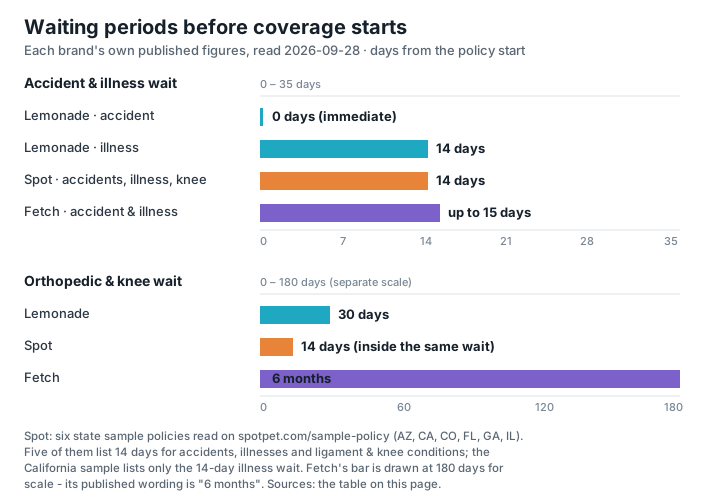
Side by side: what each brand's own pages say
| What we compare | Lemonade | Spot | Fetch |
|---|---|---|---|
| Accident waiting period | 0 days - the guide's own table prints Accidents: 0 days, next to an industry range of 0 to 2 days, and says accident coverage "kicks in immediately, with no waiting period at all" (checked 2026-11-09) source: www.lemonade.com | 14 days: the AZ, CO, FL, GA and IL Accident & Illness sample policies say 14 days for "accidents, illnesses and ligament and knee conditions"; the California sample's waiting-period section states only the 14-day illness wait and no separate accident figure (checked 2026-11-09) source: spotpet.com | Not published as its own figure - Fetch publishes one combined accident and illness wait of up to 15 days instead (checked 2026-11-09) |
| Illness waiting period | 14 days, counted from the policy's start date (checked 2026-11-09) source: www.lemonade.com | 14 days: "Spot plans typically have a 14 day waiting period for coverage" (FAQ) and every state sample policy read repeats the 14-day figure (checked 2026-11-09) source: spotpet.com | Up to 15 days, beginning the day after you enroll; claims submitted during it are not paid (checked 2026-11-09) source: www.fetchpet.com |
| Orthopedic, cruciate and hip dysplasia | 30 days for orthopedic conditions - the same table prints an industry range of 6 to 12 months for that row, and the guide names hip dysplasia and a luxating patella as conditions that must not appear before the wait ends (checked 2026-11-09) source: www.lemonade.com | Inside the same 14 days: the five state samples list "ligament and knee conditions" with accidents and illnesses, and the California sample lists orthopedic illness inside its 14-day illness wait (checked 2026-11-09) source: spotpet.com | 6 months before orthopedic conditions can be covered - Fetch names elbow dysplasia, hip dysplasia, intervertebral disc degeneration, patellar luxation and ruptured cranial cruciate ligaments (checked 2026-11-09) source: www.fetchpet.com |
| When the clock starts | On your policy's start date; the guide's glossary defines the effective date as the day the policy becomes active and waiting periods begin (checked 2026-11-09) source: www.lemonade.com | On "the first effective date of the applicable coverage" - the wording used in every state sample policy read (checked 2026-11-09) source: spotpet.com | The day after you enroll (checked 2026-11-09) source: www.fetchpet.com |
| Preventive / wellness care | No wait: the pet insurance page says the preventative package benefits "can be used the day after the policy is purchased" (checked 2026-11-09) source: www.lemonade.com | No wait: "Preventative care coverage has no deductible or waiting period, meaning you can start using these benefits the next day" (checked 2026-11-09) source: spotpet.com | No wait: "there is no waiting period for Fetch Wellness" - claims work on or after the effective date in the enrollment confirmation email (checked 2026-11-09) source: www.fetchpet.com |
| Anything that happens during the wait | "Anything your pet has shown signs of before the waiting periods are up is considered a pre-existing condition" - and pre-existing conditions are not covered (checked 2026-11-09) source: www.lemonade.com | "Any condition that occurs during an applicable waiting period is a pre-existing condition" (state sample policy wording) (checked 2026-11-09) source: spotpet.com | Any accident, injury or illness during the wait is considered pre-existing and is not eligible for coverage (checked 2026-11-09) source: www.fetchpet.com |
| State-by-state differences | Not published on the cited Lemonade pages - the guide prints one national table (0 / 14 / 30 days) and lists no state variations (checked 2026-11-09) | Published state by state: the FAQ says "see our sample policy for more information on your states specific waiting periods", and spotpet.com/sample-policy hosts Accident Only, Accident & Illness, Gold and Platinum sample PDFs for each state (checked 2026-11-09) source: spotpet.com | No state table: Fetch publishes one national figure and adds that waiting periods "vary by state or province and are subject to change without notice. Please see your policy" (checked 2026-11-09) source: www.fetchpet.com |
| Ways to shorten or waive the wait | Not published on the cited Lemonade pages - the waiting-period guide offers no waiver or shortened wait (checked 2026-11-09) | California only, at your cost: a Waiting Period Health Assessment - qualifying vet exam 3 days before or 7 days after the effective date, form returned within 30 days of the exam, and the wait is waived to the effective date or the day after the exam, whichever is later (checked 2026-11-09) source: spotpet.com | Knee injuries: have a vet examine your pet within 180 days of enrollment to confirm no relevant pre-existing conditions, then send that visit's "SOAP notes" with your first claim (checked 2026-11-09) source: www.fetchpet.com |
| Does the wait reset? | Yes on cancellation: cancelling in the app resets waiting periods (refunds apply within the first 30 days) (checked 2026-11-09) source: www.lemonade.com | "A new enrollment will result in new waiting periods", and anything before it is pre-existing (California sample policy, general conditions) (checked 2026-11-09) source: spotpet.com | Not published on the cited Fetch pages - the waiting-period FAQ carries no reset-on-switch statement (checked 2026-11-09) |
What Lemonade changed on 13 October 2026
Lemonade rewrote its waiting-period guide on 13 October 2026 and left the day counts alone. The table still reads accidents 0 days, illnesses 14 days, orthopedic conditions 30 days, pre-existing conditions never covered. What changed is the depth of the answers around that table: a full question-and-answer set, five worked scenarios, and a section that answers questions the company says came from Reddit.
Three of the new answers are operational rather than definitional, and they are the ones worth reading before you buy:
- The wait is counted to the minute. Illness cover begins at 12:01 AM on day 15. A pet that vomits on day 10 is not covered for whatever that turns out to be, because the condition became pre-existing before cover started.
- The scheduling date decides, not the surgery date. A procedure booked while the wait was still running is excluded even if the operation happens afterwards - Lemonade reads the booking as proof the problem was already known.
- A clean exam before symptoms is the only baseline that helps. No vet exam is required to buy a policy, and the waiting periods apply at every age, including a two-month-old puppy. What an exam does is fix your pet's health on a date, which is what a claim three months later gets judged against.
Lemonade also names what counts as "showing signs" during the wait - limping, vomiting, changes in appetite, lethargy, unusual behavior, or anything a vet notes at an exam. That list is the practical definition of a pre-existing condition, and it is wider than most owners assume: none of those needs a diagnosis attached to count.
Where Lemonade's own answers disagree
Reading the rewritten guide end to end turns up three places where answers on the same page pull against each other. None of them is dishonest, but each one changes what you should expect to be paid.
1. Is there a policy with no waiting periods? The heading says "Nope." Two answers further down say some coverage types do not have waiting periods - accidents and preventative care - and a third says no insurer offers zero waiting periods "across the board". The three are reconcilable only if "no waiting periods" means the whole policy. Read as a per-coverage question, two of the three coverages on the policy really do start on day one.
2. When does accident cover actually begin? The comparison section says accident coverage "kicks in immediately, with no waiting period at all". The FAQ says the same cover is usable "at 12:01 AM the day after purchase". Both can be true - there is no waiting period, and the policy still is not effective the instant you pay - but the two sentences only add up to an answer once you supply the second half. Buy at noon and your pet is hurt that afternoon, and this is the paragraph that decides it.
3. When does preventative care start? The guide says the preventative packages take effect "the date your policy becomes effective". The product page says you can use them "the day after you purchased the policy". That is a one-day gap in the same company's description of the same benefit, and it has been there since before the 13 October rewrite.
For a reader, the useful habit is to take the strictest version of each answer: no waiting period on accidents still means the next midnight, and preventative care still means the effective date printed on your policy rather than the day you paid.
The five scenarios Lemonade now spells out
The guide's new scenario section is the most useful addition, because each case isolates one mechanism that decides a claim. Summarised, with the mechanism named:
- A new puppy. An eight-week-old puppy insured the day it comes home, vomiting three weeks later, is covered - the 14-day wait has passed. The mechanism: hip dysplasia at six months is still inside the 30-day orthopedic wait if the policy lapsed and restarted in between. Continuous cover is what protects the second half of a dog's first year, not the first policy.
- Switching insurers. A three-year-old cat healthy for two years, switched to a new policy, starts showing urinary signs on day six. The previous insurer's history is irrelevant: the signs appeared during the new waiting period, so the condition is pre-existing under the new policy. The mechanism: a switch restarts the clock, and anything that surfaces mid-clock belongs to the new insurer as an exclusion.
- A large breed. A one-year-old German Shepherd limping at month two, with the vet suspecting hip dysplasia. Inside the 30-day orthopedic wait, so flagged pre-existing and not covered. The mechanism: for joints, the 30 days is the whole risk window, and large breeds are the ones that walk into it.
- A rescue with no history. A four-year-old rescue insured immediately. The insurer reviews whatever records exist to work out what was already there. The mechanism: an unknown history is read as possibly-symptomatic, so a clean exam soon after adoption is the only thing that turns unknown into a documented baseline.
- A senior adoption. A nine-year-old cat from a shelter. More exclusions and narrower cover are expected; new unrelated conditions after the waits are still eligible. The mechanism: on an older pet the policy buys coverage of what happens next, not of what is already happening.
All five use named people, which are illustrative examples rather than claim records, so read them as the company explaining its own rules rather than as cases it adjudicated.
The state-by-state part, in plain terms
Only Spot puts this in writing. Its FAQ ends with "See our sample policy for more information on your state's specific waiting periods", and Spot's sample-policy page publishes a separate Accident Only and Accident & Illness PDF for each state. Reading six of them on 2026-11-09 shows what that means in practice: five states carry the identical sentence (14 days covering accidents, illnesses and ligament and knee conditions), while California's form covers 14 days of illness only - including congenital, hereditary and orthopedic illness - and offers a paid Waiting Period Health Assessment that the other forms do not mention.
Fetch does not publish a state table; its home page simply warns that waiting periods "vary by state or province" and tells you to read your policy. Lemonade's guide prints one national table: 0 / 14 / 30. So if your state matters, Spot is the only one of the three that hands you the documents directly - everyone else asks you to read the policy you are given.
Every figure with its official source
| Fact | Condition to get it | Official source page | Checked |
|---|---|---|---|
| Lemonade's published waiting periods are 14 days for illnesses and 30 days for orthopedic conditions, and they begin on the policy's start date | Waiting-period guide, section "How do pet insurance waiting periods work?"; the page is marked Last Updated: Oct 13, 2026 | https://www.lemonade.com/pet/insurance-guide/waiting-periods/ | 2026-11-09 |
| Lemonade prints its own comparison table: accidents 0 days (industry range 0 to 2), illnesses 14 days (14 to 30), orthopedic conditions 30 days (industry range 6 to 12 months), pre-existing conditions never covered | Table under "How do Lemonade's waiting periods compare to other providers?" - the industry range column is Lemonade's own framing, not a measured survey | https://www.lemonade.com/pet/insurance-guide/waiting-periods/ | 2026-11-09 |
| Accident coverage at Lemonade kicks in immediately, with no waiting period at all | Same guide page; the FAQ on that page also answers "Is there pet insurance with no waiting periods?" with "Nope" - every policy on the site has waiting periods on some coverage | https://www.lemonade.com/pet/insurance-guide/waiting-periods/ | 2026-11-09 |
| Lemonade's preventative care coverage kicks in the date the policy becomes effective | Guide, "Are there any exclusions to pet insurance waiting periods" - applies to the preventative care options added to the policy | https://www.lemonade.com/pet/insurance-guide/waiting-periods/ | 2026-11-09 |
| Lemonade's pet insurance page words the same benefit as usable "the day after the policy is purchased", and says cancelling in the app resets waiting periods | FAQ answer on the product page; the 30-day refund window is the first 30 days of the policy - note the two Lemonade pages describe the preventive start one day apart (guide: effective date; product page: day after purchase) | https://www.lemonade.com/pet-insurance | 2026-11-09 |
| "Anything your pet has shown signs of before the waiting periods are up is considered a pre-existing condition", and pre-existing conditions are not covered | FAQ on Lemonade's pet insurance page | https://www.lemonade.com/pet-insurance | 2026-11-09 |
| Spot: "Spot plans typically have a 14 day waiting period for coverage", followed by "See our sample policy for more information on your states specific waiting periods" | Question "What is a waiting period for pet insurance?" in the FAQ block on Spot's home page; the sample policy link points to spotpet.com/sample-policy | https://spotpet.com/ | 2026-11-09 |
| Spot's Arizona, Colorado, Florida, Georgia and Illinois Accident & Illness sample policies all say: "There is a 14 day waiting period for: diagnosis, treatment or surgery related to accidents, illnesses and ligament and knee conditions. The waiting period begins on the first effective date of the applicable coverage." | Five state sample PDFs linked from spotpet.com/sample-policy, read 2026-11-09: AZ and CO form PET-P-20000-1024, FL PET-P-20000-FL-1024, IL PET-P-20000-IL-1024, GA PET-P-20000-0723 (same waiting-period sentence in all five) | https://spotpet.com/sample-policy | 2026-11-09 |
| Spot's California Accident & Illness sample policy reads differently: "There is a 14 day waiting period for diagnosis, treatment or surgery related to any illness, including... congenital anomaly or disorder, hereditary disorder and orthopedic illness", with no separate accident sentence in that section | California sample PDF PET-P-20000-CA-IAIC-1024 (Independence American Insurance Company) linked from spotpet.com/sample-policy, read 2026-11-09 - this is the state-level wording difference Spot's FAQ points to | https://spotpet.com/sample-policy | 2026-11-09 |
| Spot's California policy adds a paid way to change the wait: a Waiting Period Health Assessment - qualifying vet exam 3 days before or 7 days after the initial effective date, form returned within 30 calendar days of the exam, and "the waiting period will be waived to either the policy period effective date or the day after the qualifying exam, whichever is later" | California sample PDF PET-P-20000-CA-IAIC-1024, WAITING PERIODS section; the policy says "You may elect at your cost", and the waiver does not alter the pre-existing conditions exclusion | https://spotpet.com/sample-policy | 2026-11-09 |
| Spot's Accident Only sample policy for Arizona also uses 14 days: "There is a 14 day waiting period for: diagnosis, treatment or surgery related to accidents and ligament and knee conditions" | AZ Accident Only sample PDF linked from spotpet.com/sample-policy, read 2026-11-09 | https://spotpet.com/sample-policy | 2026-11-09 |
| Spot: a curable pre-existing condition that has been cured and free from treatment and symptoms for 180 days counts as a new occurrence - but that carve-out "does not apply to chronic conditions or ligament and knee conditions" in the AZ, CO, FL and IL samples, while the GA sample's sentence omits chronic conditions | CURED CONDITION ELIGIBILITY section of the state sample policies, read 2026-11-09; the exact exclusion list differs between form versions | https://spotpet.com/sample-policy | 2026-11-09 |
| Spot: "Preventative care coverage has no deductible or waiting period, meaning you can start using these benefits the next day" | Preventative care description on Spot's dog insurance page | https://spotpet.com/dog-insurance | 2026-11-09 |
| Fetch: "The waiting period, which begins the day after you enroll, is a set period of time, of up to 15 days, before your coverage kicks in"; conditions during it are pre-existing and claims submitted during it are not covered | Fetch FAQ page "What is a waiting period for pet insurance?", read 2026-11-09 | https://www.fetchpet.com/faqs/waiting-period | 2026-11-09 |
| Fetch also applies "a 6-month waiting period before orthopedic conditions can be covered", and lists elbow dysplasia, hip dysplasia, intervertebral disc degeneration, patellar luxation and ruptured cranial cruciate ligaments as orthopedic conditions | Same Fetch FAQ; it then offers the knee waiver: a vet exam within 180 days of enrollment with "SOAP notes" submitted with the first claim | https://www.fetchpet.com/faqs/waiting-period | 2026-11-09 |
| Fetch: "No, there is no waiting period for Fetch Wellness" - wellness claims work on or after the effective date given in the enrollment confirmation email | Fetch FAQ "Is there a waiting period for pet wellness?", read 2026-11-09 | https://www.fetchpet.com/faqs/is-there-a-waiting-period-for-pet-wellness | 2026-11-09 |
| Fetch's home page disclaimer: "Policy activation periods, risk free cancellation terms, waiting periods, limitations, exclusions to coverage and other terms and conditions vary by state or province and are subject to change without notice. Please see your policy for full terms" | Footer disclaimer on fetchpet.com; the site publishes a single national waiting-period figure in its FAQ and no state-by-state table (checked 2026-11-09) | https://www.fetchpet.com/ | 2026-11-09 |
| Lemonade's waiting-period guide is now marked Last Updated: Oct 13, 2026 - it was marked Jun 3, 2026 when this page first cited it, and the whole guide was rewritten around the same 0 / 14 / 30 day table | The date line at the top of the guide. The table beneath it is unchanged: accidents 0 days, illnesses 14 days, orthopedic conditions 30 days, pre-existing conditions never covered | https://www.lemonade.com/pet/insurance-guide/waiting-periods/ | 2026-11-09 |
| Illness coverage starts at "12:01 AM on day 15" of a 14-day wait - and a pet that shows symptoms on day 10 is not covered for that condition, because the wait has to finish completely before coverage begins | FAQ "Will my pet be covered if they get sick on day 10 of a 14-day waiting period?" - the clock is counted to the minute, not to the day | https://www.lemonade.com/pet/insurance-guide/waiting-periods/ | 2026-11-09 |
| Lemonade lists what counts as "showing signs" during the wait: limping, vomiting, changes in appetite, lethargy, unusual behavior, or symptoms a vet observes during an exam | FAQ "What counts as showing signs of an illness during the waiting period?" - these are the observations that convert a later diagnosis into a pre-existing condition | https://www.lemonade.com/pet/insurance-guide/waiting-periods/ | 2026-11-09 |
| A surgery or treatment scheduled before the waiting period ends is not covered even when the procedure itself takes place after the wait, because the timing shows the condition was already present or suspected | FAQ "Can I get reimbursement for a surgery that was scheduled before the waiting period ended?" - the scheduling date matters, not the surgery date | https://www.lemonade.com/pet/insurance-guide/waiting-periods/ | 2026-11-09 |
| Lemonade says no vet exam is required before buying a policy, and that waiting periods apply to every pet regardless of age - including a two-month-old puppy | FAQs "Do I need to take my pet for a vet exam before I can get insurance?" and "If my puppy is only 2 months old, does the waiting period still apply?" - only the preventative add-on starts without a wait | https://www.lemonade.com/pet/insurance-guide/waiting-periods/ | 2026-11-09 |
| Lemonade defines orthopedic conditions as those affecting bones, joints, ligaments and tendons - naming cruciate ligament injuries, hip dysplasia and arthritis as examples - and says the 30-day wait exists because these develop gradually or have genetic components | FAQ "What are orthopedic conditions and why do they have a 30-day waiting period?" - arthritis is named inside the orthopedic bucket, not treated as an illness | https://www.lemonade.com/pet/insurance-guide/waiting-periods/ | 2026-11-09 |
| Lemonade states the policy itself goes into effect at "12:01 AM the day after purchase", and that there is "no such thing as truly same-day coverage" | FAQs "How long does pet insurance take to go into effect?" and "Can pet insurance be active the same day?" - the answer sits next to the claim that accident cover "kicks in immediately" | https://www.lemonade.com/pet/insurance-guide/waiting-periods/ | 2026-11-09 |
| Spot's own waiting-period blog prints the same industry spread Lemonade does: accidents "usually range from 0-15 days", orthopedic conditions "often 6-12 months", and a 14-day illness wait as the norm | Spot blog page dated 09/25/2026 - independent of the state sample policies already cited on this page, and consistent with them | https://spotpet.com/blog/why-pet-insurance/what-is-the-waiting-period-in-pet-insurance | 2026-11-09 |
Pet insurance waiting periods - FAQ
What is a pet insurance waiting period?
Spot's own definition: "A waiting period is a set period between the day you enroll and the day your coverage begins. Conditions that occur during the waiting period will be considered pre-existing and will not be eligible for coverage under your plan." Fetch words it as the gap between enrollment and when coverage kicks in, and Lemonade calls it the time the insurer requires you to wait until your pet is eligible for reimbursement on specific conditions (all checked 2026-11-09).
Source: https://spotpet.com/ · checked 2026-11-09
How long is the waiting period with Lemonade?
0 days for accidents, 14 days for illnesses and 30 days for orthopedic conditions, counted from the policy's start date. Preventive care from a preventative package can be used the day after purchase. That is the whole national table Lemonade publishes - no state-by-state version appears on the pages cited here (checked 2026-11-09).
Source: https://www.lemonade.com/pet/insurance-guide/waiting-periods/ · checked 2026-11-09
How long is the waiting period with Spot?
Spot says its plans "typically" have a 14-day waiting period and then points you at the sample policy for your state's specific waiting periods. Of the six state Accident & Illness samples read on 2026-11-09 (AZ, CA, CO, FL, GA, IL), five state 14 days covering accidents, illnesses and ligament and knee conditions; the California sample states 14 days for illness only and adds a paid Waiting Period Health Assessment that can waive it. Preventive care add-ons start the next day.
Source: https://spotpet.com/sample-policy · checked 2026-11-09
How long is the waiting period with Fetch?
Up to 15 days for accident and illness coverage combined, beginning the day after you enroll, plus a separate 6-month waiting period before orthopedic conditions - hip dysplasia, elbow dysplasia, luxating patella, IVDD and ruptured cruciate ligaments are named. Fetch Wellness has no waiting period. Fetch also publishes a knee waiver: a vet exam within 180 days of enrollment with SOAP notes sent in your first claim (checked 2026-11-09).
Source: https://www.fetchpet.com/faqs/waiting-period · checked 2026-11-09
Do waiting periods change from state to state?
For Spot, yes - that is what its FAQ means by "see our sample policy for more information on your states specific waiting periods": spotpet.com/sample-policy hosts separate Accident Only and Accident & Illness sample PDFs per state, and the sentences are not identical (the California sample has no separate accident sentence and offers a waiver the others do not). Fetch does not publish a state table but disclaims that waiting periods vary by state or province. The two Lemonade pages read print one national table only (checked 2026-11-09).
Source: https://spotpet.com/sample-policy · checked 2026-11-09
Can you shorten or waive a pet insurance waiting period?
Fetch publishes a way for knees: have your pet examined by a vet within 180 days of enrollment to show no relevant pre-existing conditions, then submit that visit's SOAP notes with your first claim. Spot's California sample policy offers a paid Waiting Period Health Assessment (exam 3 days before or 7 days after the effective date, form returned within 30 days) that waives the wait to the effective date or the day after the exam, whichever is later. The Lemonade pages cited here publish no such option (checked 2026-11-09).
Source: https://www.fetchpet.com/faqs/waiting-period · checked 2026-11-09
What happens if my pet gets sick during the waiting period?
All three treat it as pre-existing: Fetch says any accident, injury or illness during the wait "will be considered a pre-existing condition, which means it won't be eligible for coverage"; Spot's sample policy says any condition occurring during a waiting period is a pre-existing condition; Lemonade says anything your pet showed signs of before the wait ended counts as pre-existing. Spot adds that a curable pre-existing condition can count as new after 180 days symptom- and treatment-free, except chronic and ligament/knee conditions in the samples read (checked 2026-11-09).
Source: https://www.fetchpet.com/faqs/waiting-period · checked 2026-11-09
Do wellness and preventive add-ons have a waiting period?
No, according to all three brands' own pages: Fetch Wellness claims work "on or after the effective date" in your enrollment email; Spot says preventive care has no deductible or waiting period and starts the next day; Lemonade says preventative care coverage kicks in on the effective date (its product page says the day after purchase). The base accident and illness waits above still apply (checked 2026-11-09).
Source: https://www.fetchpet.com/faqs/is-there-a-waiting-period-for-pet-wellness · checked 2026-11-09
Does switching insurers restart the waiting periods?
Yes - that is the coverage gap Lemonade defines in its own glossary: "A period when switching providers where your pet may temporarily lack full coverage, since new waiting periods apply with each new policy." Spot's California sample policy says the same thing for a new enrollment: "A new enrollment will result in new waiting periods", and conditions before it are pre-existing. This is why switching mid-treatment can cost coverage (checked 2026-11-09).
Source: https://www.lemonade.com/pet/insurance-guide/waiting-periods/ · checked 2026-11-09
If my pet shows symptoms on day 10 of a 14-day wait, is that condition covered?
No. Lemonade's guide answers this one directly: the wait has to end completely, so illness coverage starts at 12:01 AM on day 15, and symptoms that appear before then make the condition pre-existing. The same logic applies to a surgery booked during the wait - it stays excluded even if it happens afterwards, because the booking shows the problem was already known (checked 2026-11-09).
Source: https://www.lemonade.com/pet/insurance-guide/waiting-periods/ · checked 2026-11-09
Do I need a vet exam before I can buy pet insurance?
Not with Lemonade - it says plainly that no exam is required before buying. What an exam does is create a dated record of your pet's health, and that record is what a later claim is measured against. Lemonade's rescue-pet scenario makes the point: an unknown history gets read as possibly-symptomatic, so a clean exam soon after adoption is the only thing that turns it into a baseline (checked 2026-11-09).
Source: https://www.lemonade.com/pet/insurance-guide/waiting-periods/ · checked 2026-11-09
Does the waiting period still apply to a very young puppy?
Yes. Lemonade states that waiting periods apply to all pets regardless of age, even a two-month-old puppy: 14 days for illnesses and 30 days for orthopedic conditions. The exception is the preventative care add-on, which starts as soon as the policy takes effect (checked 2026-11-09).
Source: https://www.lemonade.com/pet/insurance-guide/waiting-periods/ · checked 2026-11-09
Is arthritis treated as an illness or an orthopedic condition?
Orthopedic. Lemonade's new FAQ defines orthopedic conditions as those affecting bones, joints, ligaments and tendons and names cruciate ligament injuries, hip dysplasia and arthritis among the examples - which puts arthritis behind the 30-day wait rather than the 14-day one (checked 2026-11-09).
Source: https://www.lemonade.com/pet/insurance-guide/waiting-periods/ · checked 2026-11-09
Is there really such a thing as a pet insurance policy with no waiting periods?
Not as a whole policy. Lemonade's guide answers the whole-policy question with one word - "Nope" - while separately saying that accident cover and preventative care have no waiting period at all. Both statements are on the same page. The practical reading: no policy has zero waits, but two of its coverages can start on day one (checked 2026-11-09).
Source: https://www.lemonade.com/pet/insurance-guide/waiting-periods/ · checked 2026-11-09
Every brand on this site, page by page
Lemonade
Starts at $10/mo
Basic accident and illness coverage; actual price varies by coverage choices, breed, age and location (Lemonade cost guide, re-read 2026-11-09 and marked Last Updated: Oct 13, 2026; the figure itself was unchanged).
Lemonade pet insurance starts at $10/month for basic accident and illness coverage, reimburses on a customizable co-insurance/deductible basis, and pays claims through its app.
Spot
Dogs from $15/mo, cats from $9/mo
Advertised premiums: the dog figure is from an accident and illness plan with 80% reimbursement rate, $500 annual deductible and $2,500 annual limit for a 2-year-old small mixed dog (11-25 lbs) in ZIP 32009; the cat figure is from 80% reimbursement, $750 annual deductible and $2,500 annual limit for a 2-year-old mixed cat in ZIP 33801. Plan costs vary.
Spot pet insurance advertises dog plans from $15/month and cat plans from $9/month, reimburses up to 90% of covered vet bills, and pays most claims in under 2 business days.
Fetch
Avg $35/mo dogs, $22/mo cats
Based on U.S. annual premiums using the most common coverage configuration of a $10,000 annual limit, $300 deductible and 80% reimbursement rate for the period 07.01.2024 through 06.30.2025.
Fetch pet insurance averages $35/month for dogs and $22/month for cats on its own published figures, reimburses up to 90% of covered vet bills, and covers exam fees up to $250 per sick visit.
Related guides
This page is not affiliated with Lemonade, Spot or Fetch. It repeats only what each brand publishes on its own guide pages, FAQ pages, product pages and sample policies, with the source and check date attached to every figure; waiting periods depend on the policy you are actually sold, your state and your pet's history, and the policy wording always governs. Facts last checked 2026-11-09.